When Rules Prevail Over Common Sense
I have struggled trying to accurately recall the Right-of-Way rule because it defies my logic and personal experience. So much so that in order to remember, I must recall it as opposite to what I would normally deduce. This (hu)man-date defies my intuition, which is why I feel compelled to challenge this practice in favor of a new one.
Right of Way: Old vs MY Perspective


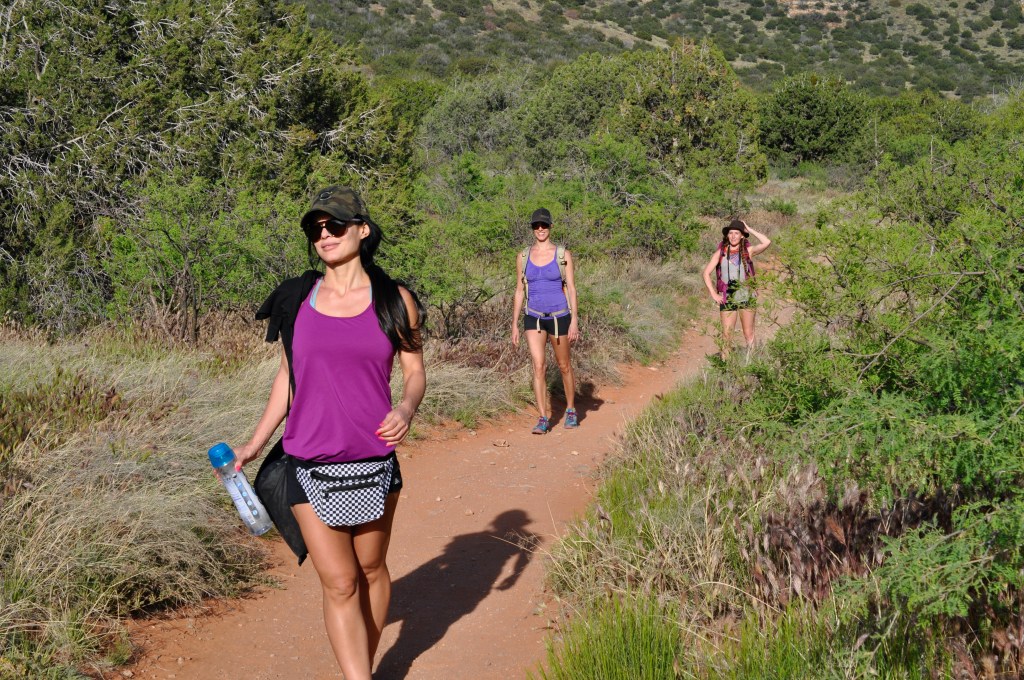
I have a few issues with a section of this rule. First, with most of my experiences hiking, the uphill hiker is the one who prefers to yield. Secondly, yielding is subjective and should not be a rule, but a situational courtesy at best. Rules mean there is a standard, governing action, yet yielding to an uphill hiker is not what is always done in practice. Therefore, it really should not even be called a rule. Third, why does this ordinance fuel the Hiking Police to snootily enforce this assumed hiking protocol?

I understand the horse rule — this is a large, unpredictable, and powerful animal who should be given plenty of space. Yielding to a horse is the standard, governing action which should take place and not be deviated from. This is a good and true rule (and common sense too).
Cyclists yielding to all — sure, when bikers are close they need to alert others, but let’s get one thing straight: bikers will eventually pass most hikers. So, are they really and truly yielding? The stipulation should be: cyclists need to make their presence known before passing.
Downhill hikers yielding to those moving uphill — this is what I am truly challenging in the following points. I first want to begin with a reminder of the initial premise for establishing this code: maximizing safety.


Point 1: Momentum
An upward moving body that is leaning forward against gravity is likely more balanced and not moving very fast. Oppositely, a downhill hiker has more momentum and is likely a tad less stable. It stands to reason to allow the less stable individual to dictate the terms of the interaction to ensure a successful interaction. Let’s be real too: in practice, most of the time the people going UP appreciate taking a little breather to allow the downhill hiker to pass.
The downhill cruise is one of those added bonuses we revel in while hiking: after all the hard uphill work, we finally get to enjoy going down faster and with less effort.
Point 2: Risk
As mentioned, downhill hikers are moving faster (gravity) and will require much more effort to stop when compared to an upward moving body. Additionally, the risk is increased when a forward-moving body must be completely halted over uneven, coarse terrains.
Point 3: Time
A descender will usually clear the area far more quickly than an ascender over the same distance. The interaction lasts much longer when yielding to an uphill hiker.
Point 4: Flow State Not Just For Ascenders
An uphill hiker may get into a flow as they truck along, but a downhill hiker most certainly can reach a flow state too! We have all been there: the sturdy rocks revealing themselves easily; dodging bushes and trees casually without missing a beat; your breath in line with your steps and you feel unstoppable. Until, of course, you connect with an uphill hiker.

Flatiron Trail, Superstition Wilderness
Point 5: We all have welcomed a reprieve to make way for a descender
But what really gets my goat is when a hiker arrogantly advises on the Right-of-Way rule as if they were the Hiking Police. I have never officially agreed to following this rule, and I like to communicate on the trail. WHO decided on these rules, anyways?
Enjoy the hike and read the situation. It is not always so black and white; the circumstances matter. And humans still are social creatures, so don’t forget that you, too, can communicate.
Ren Fou
MORE TRAIL READING
Something went wrong. Please refresh the page and/or try again.


Leave a Reply to Explore 2 Mesquite Bosques in the Cave Creek Desert – OPTOUTSIDEAZ Cancel reply